//Rosatom/VNIIEF

RUSSIAN FEDERAL NUCLEAR CENTER
ALL-RUSSIAN RESEARCH INSTITUTE OF EXPERIMENTAL PHYSICS
ALL-RUSSIAN RESEARCH INSTITUTE OF EXPERIMENTAL PHYSICS
 Site map
 Contacts
 Feedback
ASC "ROSATOM" COMPANY
With its great computation, experimentation and production capabilities, RFNC - VNIIEF is a complex of closely interrelated institutes: Institute of Theoretical and Computational Physics, Institute of Experimental Gas Dynamics and Detonation Physics, Institute of Nuclear and Radiation Physics, and Institute of Laser Physics. Also, it includes Research Center for High Energy Density and Beam Physics, Electrophysics Division, Design Bureaus, and Production Engineering and Conversion operations.
Organized in this way, the Institution is able, along with its primary mission to improve and maintain our national nuclear weapons capabilities, to effectively address both the fundamental science and national economy tasks.
The VNIIEF programmatic activities mainly include:
- high energy density physics;
- computer simulations and information technologies;
- high-power laser technology and laser physics;
- inertial confinement fusion;
- gasdynamics and detonation physics;
- nuclear and radiation physics;
- high-voltage technology;
- development and deployment of advanced control and accountability techniques for fissile materials;
- innovative technologies and advanced materials;
- environment control and monitoring;
- nuclear power safety;
- non-nuclear weapons;
- development of various devices and equipment for commercial use in national economy.
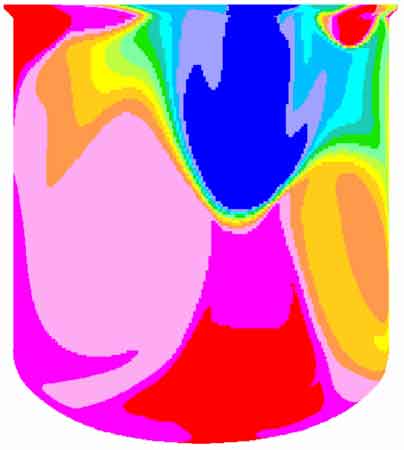 |
Calculated/theoretical simulation methods are pursued by the Institute of Theoretical and Computational Physics (ITMF), constituent of RFNC-VNIIEF.
Based on the pre-upgraded physical and mathematical material, ITMF focuses on development of further updated mathematical models and software, assigned for solution of operation safety and reliability problems, associated with weapon components in the environment of total banning of full-scale natural nuclear tests. Specialists, employed by the Institute, are the authors of several numerical problem-solving methods, unique software codes for computerized calculations, as well as databanks and libraries, containing manifold data on material properties. The new technologies assigned for theoretical/calculated studies associated with the basic spheres of activities pursued by RFNC-VNIIEF were also mastered.
Serious success was achieved in the following spheres:
- computerized simulation of multi-dimensional tasks of nuclear explosion physics and laser physics in the complete and closed setup, with all the basic physical processes considered for simultaneously;
- study of characteristics of turbulence phenomenon;
- development of multi-processor computational systems and modern computational networks;
- development of the effective methods of multisequencing, which accelerated calculation of the most complicated multi-dimensional non-stationary problems for up to 2 times and over;
- development of mathematical simulation methods of thermal radiation transport, HE combustion and detonation, hydro-dynamical instability and some other issues, using more complete and precise from the qualitative viewpoint physical and mathematical models.
 |
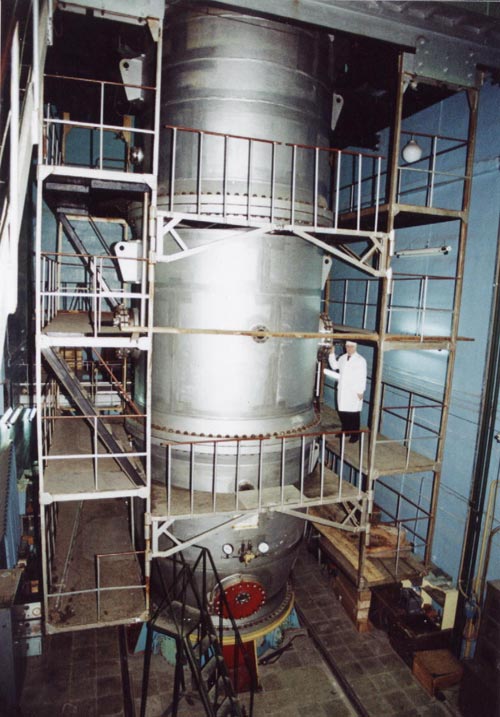
Institute of Exsperimental Gas Dynamics and Detonation Physics conducts research and experimental work that becomes more and more significant today. First, this is investigations into the properties of materials at high and ultra-high pressures, and material strength and kinetics under shock loads, the detonation and combustion behaviors of explosive materials, research on shock waves and non-steady dynamic flows. The Institute capabilities include advanced package of diagnostics and procedures for transient studies.
The Institute scientists have developed some new laboratory-scale techniques for experimental study of hydrodynamic behaviors. In particular, these are thin-film gas models in combination with varied shock tubes, or jelly simulation of unsteady hydrodynamic flows, or liquid layers technique. Some methods have been adopted by the researchers in the USA, France and UK.
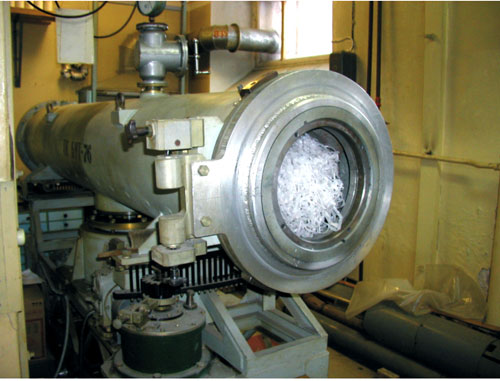
The Institute has an X-ray radiography facility, which is built around the RFNC - VNIIEF-designed betatrons and systems of soft radiation spectrum. These machines allow double-angle multi-frame radiography of the material state and structural behaviors under explosive loading.
The result of such radiography studies was the wide-range equations of state developed for condensed substances and gases (up to 100 Mbar), and wide-range shear and spall strength models of the critical structural materials.
The record number of DT reactions - ~ 4x10¹³ was achieved in gasdynamic ICF research. Studies in the physics and chemistry of high explosives have provided explosive technologies that are used in peaceful applications, namely: mining industry, simulation of seismic effects, explosive disassembly of structures, or dynamic synthesis of materials.
 |
The Institute of Nuclear and Radiation Physics has a small-size linear resonance electron accelerator LU-7-2 in operation now as a supplement to the PULSAR equipment for NDA tests of large-size industrial items. In cooperation with the All-Russian Eye and Plastic Surgery Center (Ufa), a LU-7-2 modification of "Alloplant" series has been designed and is on construction now for the purpose of allotransplants sterilization.
In 1997, RFNC - VNIIEF was admitted to the ALICE (A Large Ion Collider Experiment) international collaboration, a program in which the VNIIEF's task is to perform research and development towards building the photon and muon spectrometers for the international Large Hadron Collider (LHC) project.
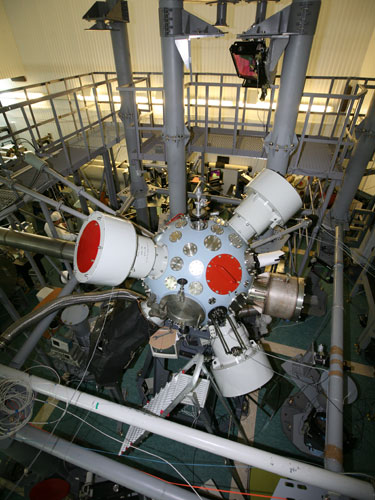 |
The energetic efforts of the experts employed by the Institute, combined with the efforts of certain domestic institutions, yielded the family of powerful laser facilities named "ISKRA". The twelve-channel 120 TW facility "Iskra-5", having no analogs in Europe and Asia, became the stem of the present experimental complex. Studies in the following scientific areas are underway: laser fusion, interaction between laser radiation and dense plasma, physical processes in hot and dense plasma and magnetosheric storms. The record high-temperature plasma with ion component temperature ~ 12 keV was achieved experimentally. Neutron yield of up to 1010 DD-neutrons per pulse was recorded.
A concept of UFL-2M facility was developed, featuring the following parameters: laser radiation energy 2.8 MJ at 0.53 mcm wavelength; number of channels – 192; laser pulse duration (2-10) ns; form of laser pulse – shaped. The facility is assigned for profound studies covering a wide spectrum of areas in the field of high energy density physics, particularly under conditions of thermonuclear fuel ignition and combustion. Work on development of the facility is started in 2012. Estimated period of finalization late 2020.
Significant progress was achieved in photo-dissociation gas lasers, pulsed and pulsed-periodic fluorine-hydrogen chemical lasers, continuous CO2 gas-dynamic lasers and continuous iodine-oxygen chemical lasers.
The great experience developed at VNIIEF along the above research activities contributed to the success of joint projects and experiments with Los Alamos National Laboratory in US and Direction des applications militaires de Commisariat a l'energie atomique (CEA/DAM) in France.
The interest in ultrahigh magnetic fields is motivated by the huge energy density that is potentially achievable in magnetic field.
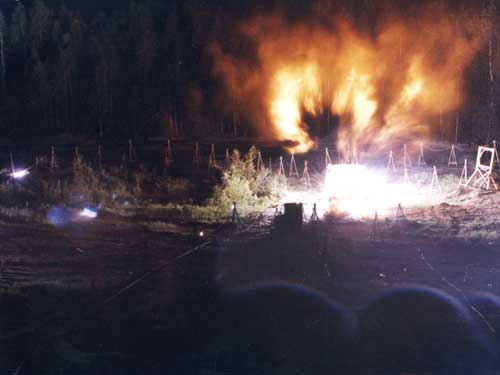 |
Based on the explosive magnetic generator EMG-320, the Center scientists in 2000 were the first in the world to build and test a lightning current simulator that can provide current pulses as high as 100 kA of 200 mus width at half-maximum on a grounding rod of 160 Ohm/m specific resistance. This energy source is intended for research in design of lightning protection earth. The initial experiments observed more than a factor of 10 decrease in active resistance of the rod during the current risetime.
RFNC - VNIIEF is the world leader in cycling accelerator developments that have achieved now the current of about 300 A, i.e. two orders higher than the world results, and the energy of 100 MeV exceeding the world level by an order of magnitude.